
THOMAS COLE
Painting the Nature of America
America 250 at the Thomas Cole National Historic Site
Translating onto canvas the scenery he observed, Cole’s exquisite paintings of nature with their majestic views and awe-inspiring beauty served as a unifying force for a youthful nation struggling to establish a sense of identity. What signs and symbols would define us? Overarchingly, it was, and still is, the landscape.
—Nancy Siegel, Project Advisor and Professor of Art History, Towson University
Cole’s paintings spoke powerfully to his Jacksonian contemporaries, but they are hardly period pieces. More than 175 years after his death, his work—especially the work focused on American nature–continues to intrigue and inspire Americans living today.
—Alan Wallach, Project Advisor and Ralph H. Wark Professor of Art and Art History Emeritus and Professor of American Studies Emeritus, William & Mary
Thomas Cole’s path was individual, uncomfortable, and anything but inevitable. With his paintings and prose, he advocated for the idea of a national art grounded in the land, and saw before most others the threats that populism and demagoguery posed to the endurance of the wild nature that inspired him. His embodiment of an art that spoke truth to power is more timely than ever.
—William Coleman, Wyeth Study Center Director, Brandywine Museum of Art/Farnsworth Art Museum
Amid rapid transformations in the young nation of the United States, Thomas Cole’s paintings helped codify a sense of national identity. Even as they romanticized the American landscape, Cole’s works also reflected his keen observation of nature and the relationship he built with his local landscape near Catskill, New York. In 2026, as we reflect on the history of this nation, may we be reminded that our own relationship with the land is one of ongoing responsibility.
—Caroline Gillaspie, Assistant Curator, The American Wing, The Metropolitan Museum of Art
As we mark America’s 250th anniversary and reflect on the struggles and successes that have shaped the nation, it is fitting to consider the evolving American landscape—from wilderness to field to factory. In the early republic, no artist captured the era’s fraught relationship with progress more vividly than Thomas Cole, a tension that remains deeply present in America’s public consciousness and civic dialogue today.
—Graham C. Boettcher, PH.D., The R. Hugh Daniel Director & CEO, Birmingham Museum of Art
Thomas Cole’s deep reverence for nature endures as a cultural touchpoint in American history. His artwork and writings continue to spark vibrant conversations about our relationship with the landscape. As we look to commemorate America 250, Cole’s spirit compels us to reflect upon the natural world, where, as the artist once proclaimed in a letter to his patron Daniel Wadsworth, “It is here, in such sublime scenes that man sees his own nothingness; and the soul feels unutterably.”
—Erin Monroe, Krieble Curator of American Paintings and Sculpture, The Wadsworth
Cole’s vision continues to unfold. With each generation, we appreciate his vision anew: his art remains fresh, his horizons endless.
—Mark Mitchell, Holcombe T. Green Curator of American Paintings and Sculpture, Yale University Art Gallery
Thomas Cole’s impact on the American landscape can still be found today, his influence was wide reaching and truly defined what landscape painting was and what it could be for generations of artists.
—Ann Cannon, Curator of American Art, Fenimore Art Museum
In the mid-to-late 1820s and the 1830s Thomas Cole almost single-handedly brought landscape painting in America to new levels of critical admiration and popular acclaim. Cole’s influence on other artists was profound, and his generative role in helping establish America’s first great national school of painting—the Hudson River School—cannot be overestimated. The works Cole himself created, including American and European scenes and subjects drawn from history, literature and his own fertile imaginative were not only creations of great beauty, but also objects with complex meanings and associations that still fascinate and resonate with us today two hundred years later.
—Franklin Kelly, Deputy Director and Chief Curator, National Gallery of Art (retired)
Cole’s story, a brilliant one, is that of a man of obscure origins who brought to his adopted country a vivid and profound connection to the natural landscape and a poetic vision unparalleled in the United States at the time. These qualities inspired a will to create works of nature-centered art that have spoken to Americans across two and a half centuries about the past, present and future of nations, and the power and fragility of human ideals.
—Teresa A. Carbone, Independent Art Historian and Curator
Cole’s idea of nature extended beyond outward scenery. In his famous religious allegory, “The Voyage of Life,” he used landscape elements together with diurnal and seasonal cycles as a kind of Greek Chorus, mirroring the shifting psychological states of a Christian pilgrim progressing through the four traditional stages of life. For Cole, America’s nature was both a physical place and a metaphysical state of mind.
—Paul D. Schweizer, Director Emeritus, Munson-Williams-Proctor Arts Institute
When Thomas Cole took on his most important student, Frederic Edwin Church, who spent the years 1844 to 1846 in his Catskill studio, Cole imbued in the young artist a reverence for the direct observation of nature and taught him his practice of sketching and painting on-site studies. This relationship ensured that the first national school of landscape art in America, first launched by Cole, would flourish as Church’s renown as a landscape painter reached new heights by mid-century and beyond.
—Elizabeth Kornhauser, Ph.D., Curator Emerita, The Metropolitan Museum of Art and Senior Curator and Chair, Frederic Church Bicentennial Committee, The Olana Partnership
Thomas Cole’s arrival in New York City two centuries ago aligned his own longing to paint landscape with the latent yearning for it to blossom there…Those welcomed his ensuing impulse to venture more ambitious scenes of national import, enlarging a reputation around which a succeeding generation insured landscape’s preeminence for a half-century.
—Kevin Avery, Senior Research Scholar, The Metropolitan Museum of Art
—SPECIAL EXHIBITION—
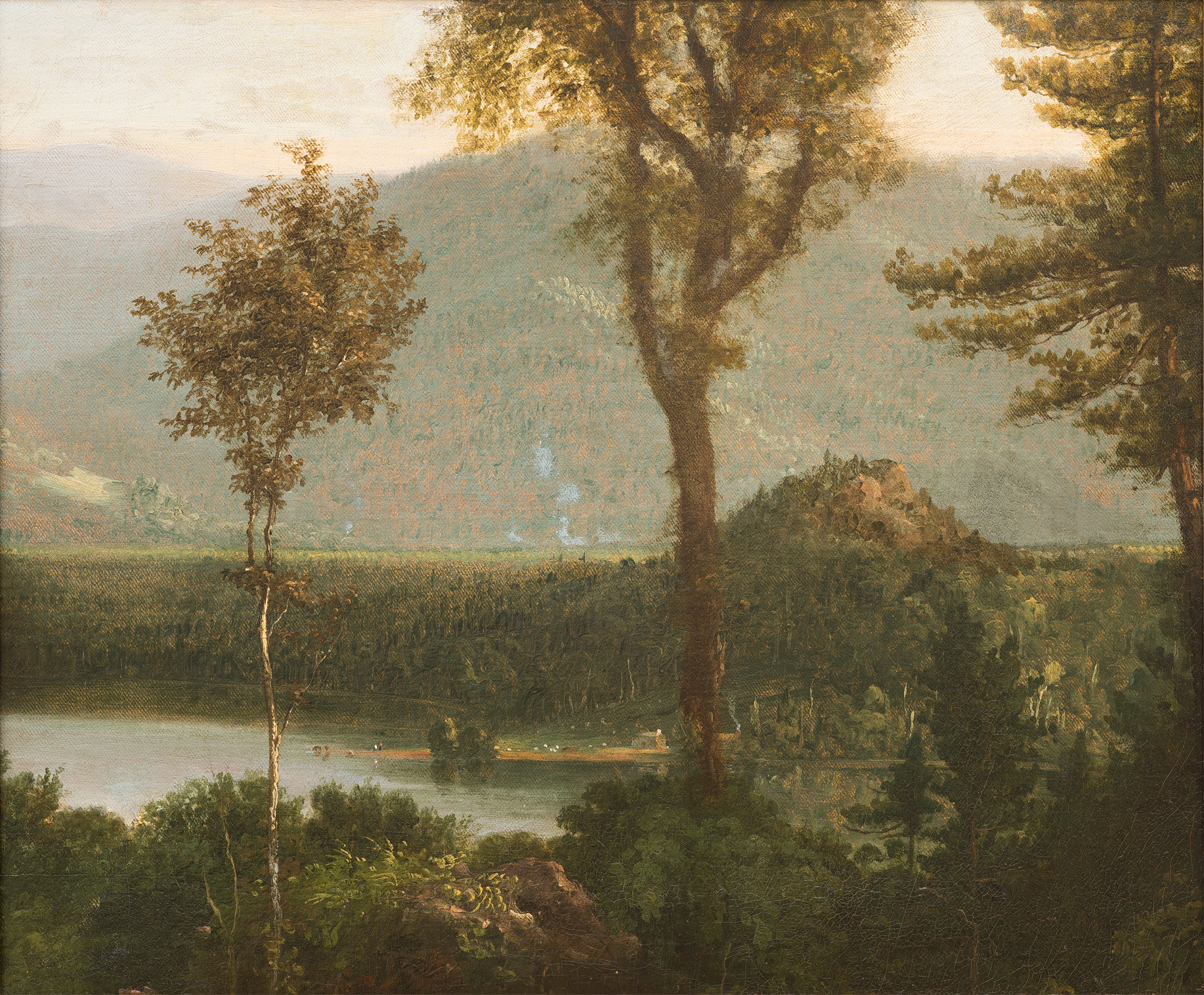
Thomas Cole: An American Visionary
April 25–Dec, 2026
A dynamic installation of Thomas Cole’s landscape paintings, painting objects, and easels. Includes an exploration of the artistic exchange between Cole and his student Frederic Church, in honor of Church 200.
In the new Richard Sharp Gallery in the Main House.
Thomas Cole, Catskill Mountain Landscape, n.d., oil on canvas, 12½ × 15½ in., Thomas Cole National Historic Site, Gift of Richard Sharp
—SPECIAL EXHIBITION—
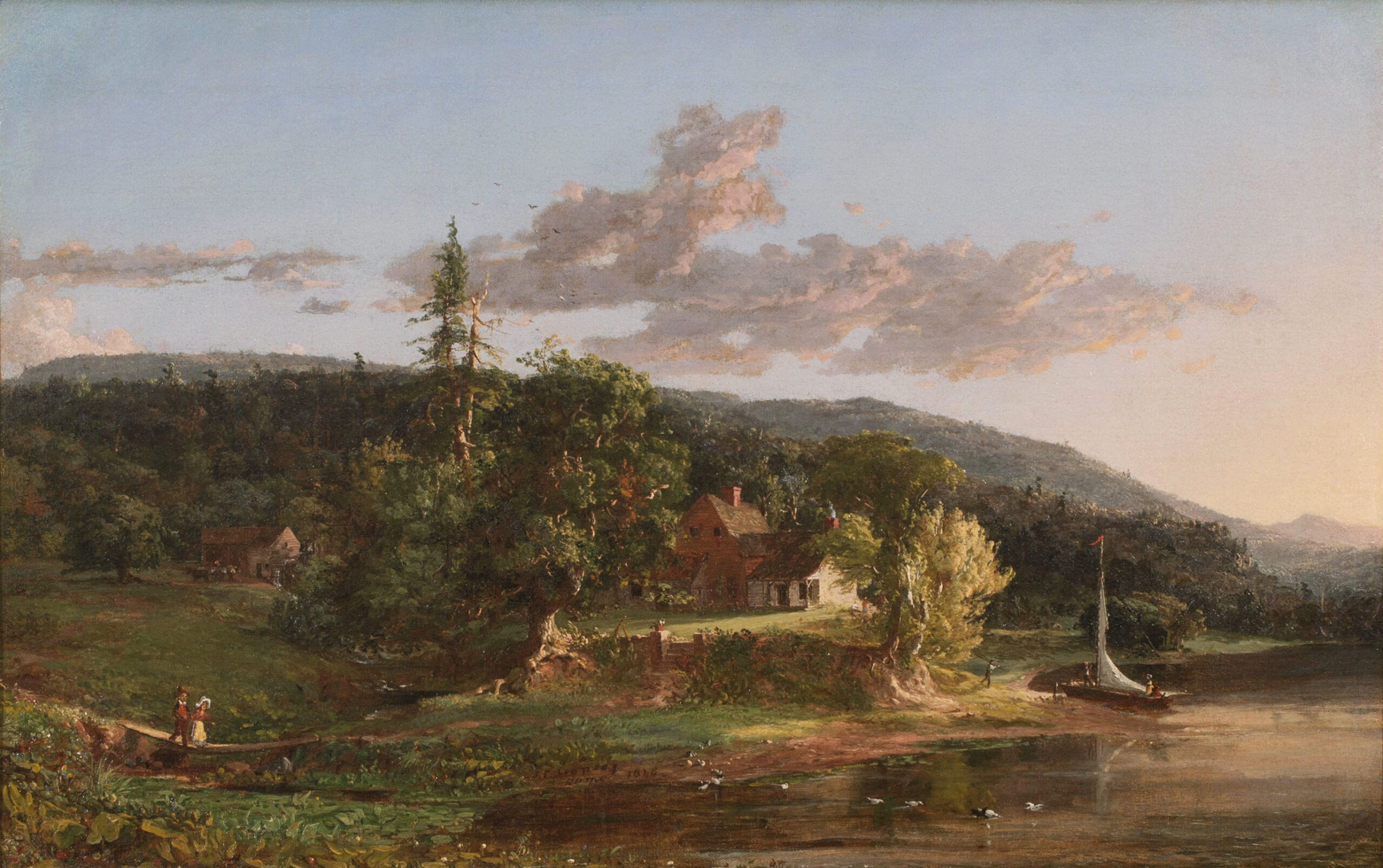
Circles of Influence: Thomas Cole and the American Landscape Movement
Jun 20–Dec, 2026
A selection of works highlighting Cole’s influence, including Frederic Church, Asher B. Durand, Jasper Francis Cropsey, Albert Bierstadt, Susie Barstow, Mary Josephine Walters, and more.
In the historic Library Gallery designed by Thomas Cole in the Main House.
Jasper Francis Cropsey, Home in the Catskills, 1848, oil on canvas, 16 x 25 in., Hawthorne Fine Art
—SPECIAL EXHIBITION—
Contemporary Vistas
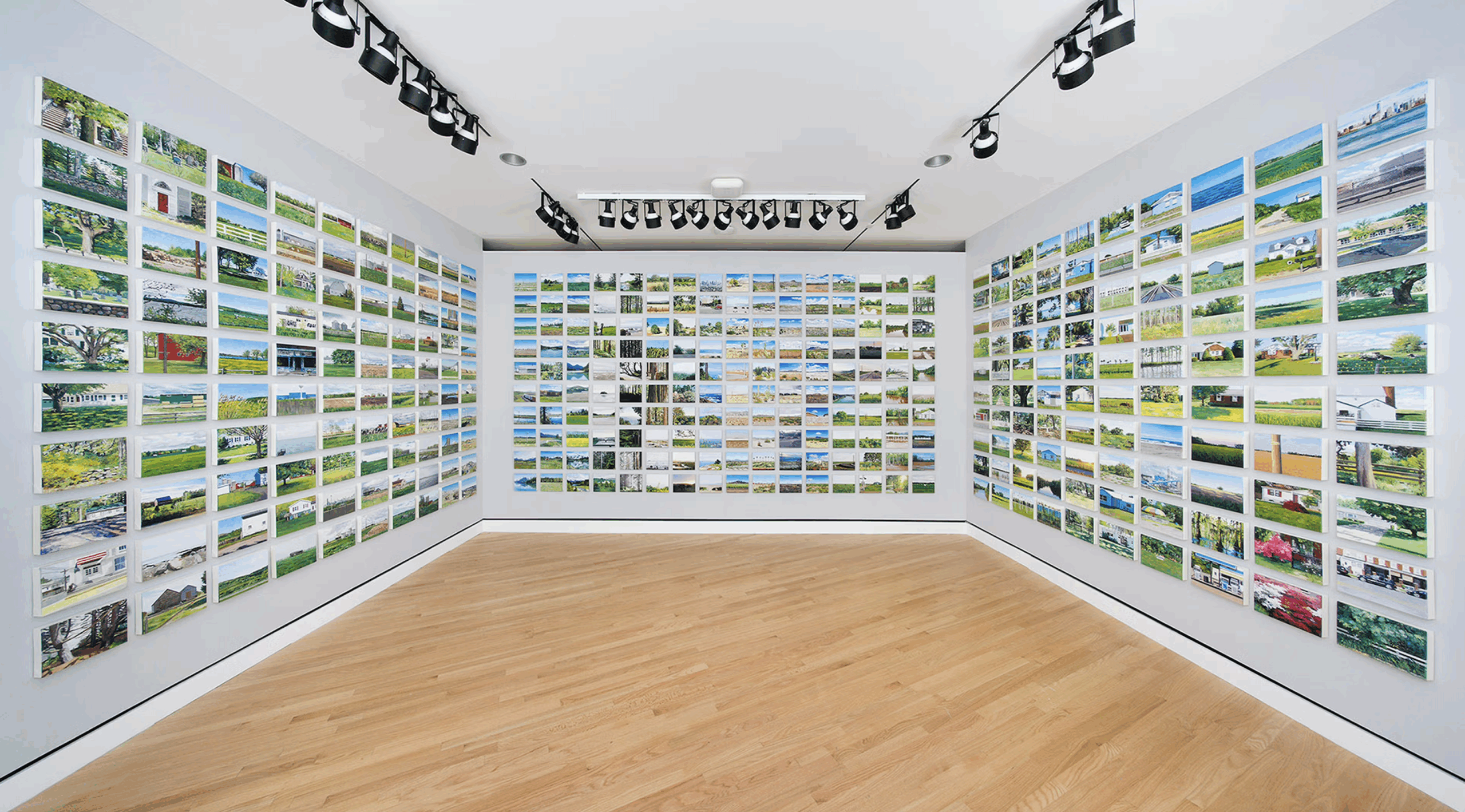
Cynthia Daignault: Light Atlas
Jun 20–Nov 1, 2026
Featuring an immersive work by Daignault inspired by Thomas Cole of 360 landscape paintings created on a road trip across the country.
In the reconstructed 1846 New Studio Building.
Cynthia Daignault, Light Atlas, 2016, oil on linen, 360 canvases, each 8 x 10 in. Art Bridges Collection. Photography Edward C. Robinson III.
—PROGRAMMING—
Jan–Dec, 2026
The Cole Site will present the Sunday Salon speaker series, featuring renowned curators and artists including Kevin Avery, Graham Boettcher, Terry Carbone, William Coleman, Cynthia Daignault, Elizabeth Kornhauser, Erin Monroe, Nancy Siegel, and Alan Wallach; the Second Saturday creative artmaking series with local makers; a Curator Tour series; a Close-Looking series, K-12 School Programs culminating in a student exhibition; a Youth Program series, a Professional Development Program for Teachers, and more.
Thomas Cole: Painting the Nature of America at the Thomas Cole National Historic Site is supported in part by The National Endowment for the Humanities: Democracy demands wisdom.
Made possible in part by the Hickory Foundation, the New York State Council on the Arts with the support of the Office of the Governor and the New York State Legislature, Jennifer Krieger and Eric Siegel, National Trust Insurance, LLC, Art Bridges, Anne and Fred Osborn III / The EASTER Foundation, Bank of Greene County Charitable Fund, Columbia Memorial Health, BST & Co. CPAs, LLP, and Eli Wilner & Company.
Also made possible in part with public funds from the Greene County Legislature through the Greene County Cultural Fund, administered in Greene County by CREATE Council on the Arts.





Any views, findings, conclusions, or recommendations expressed in this exhibition do not necessarily represent those of the National Endowment for the Humanities.
Thomas Cole & America 250 Across the Country
The U.S. State Department highlights Thomas Cole’s work in portraying America’s vast beautiful landscapes in a new national initiative, America in Brushstrokes.
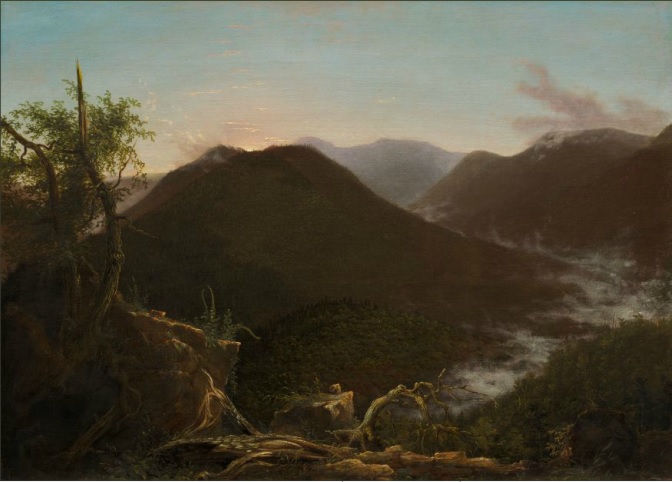
Thomas Cole, Sunrise in the Catskills, 1826, National Gallery of Art